Daffodils - If your Daffodils have stopped producing flowers, firstly ensure the bulbs are planted deeply enough. There needs to be two times the height of the bulb coverage of soil. As daffodils go through their lifecycle, the large flowering bulbs multiply to produce smaller younger bulbs which may not be mature enough yet to flower. Feed well by adding a granular high potash feed, then give a fortnightly liquid feed of Phostrogen or similar from about April until the foliage dies down. Always allow the foliage to die down naturally.
Lilies/Tulips - Never plant these together as they
suffer from the same diseases.
Snowdrops - To give bulbs a boost, apply a light
feed of a general fertiliser, eg liquid seaweed once
they have flowered and the leaves have started to die
down.
Snowdrops - Keep track of rare varieties by
planting in aquatic planters and plunging in the ground.
Tulips - After flowering, pull away leaves as soon
as they are yellow and withered. This helps to prevent disease
entering the bulbs. Then apply a liquid fertiliser to build
the bulbs up ready for next season. Feed once a week for a
month or so.
Tulips - Don't plant in the
same spot for 2 consecutive years. However, if you plant African
Marigolds where Tulips have flowered, the balance in the soil
will be restored and you can plant bulbs in the same spot
year after year.
Cats
Scare cats away from your garden by filling plastic bottles with water. Cats are frightened away by their reflections.
Add mothballs to your borders to prevent cats using them as a toilet. They don't deteriorate with the weather.
Health and Safety in the Garden
Use old comic relief red noses on the tops of your garden canes.
Make a hole in the end of wine bottle corks and place on the end of canes.
Pests,
Diseases and Weeds
Pellets based on metaldehyde are less effective in damp conditions as Slugs/Snails can
recover - they lose the chemical through their slime. Better
to use pellets based on methiocarb as it has an anti-sliming
agent.
To stop slugs and
snails nibbling your container plants, place a layer of vaseline
around the edge of the pot. They can't get over it.
Try growing Garlic
close to susceptible plants to help deter vine weevil.
Rosemary and Sage
deter Carrot Fly.
Nettle Spray is great
as a general insect repellent and plant food. Fill a bucket
with fresh nettles and water, cover and leave to ferment for
a few weeks. Strain and spray on your plants.
Marigolds,
limnanthes, calendula and poppies attract hoverflies
whose larvae eat greenfly and other aphids.
Grow
chives with roses to protect them against aphids.
Place mothballs in
containers to deter Earwigs and Ants.
Elder and Mint discourage Caterpillars.
To prevent whitefly on tomatoes, underplant with basil and marigolds.
Marjoram and Mint
help to repel ants.
When you've boiled
eggs, use the leftover water to pour between the cracks in
the path to prevent weeds growing.
To help prevent Cabbage Root Fly, cut disk shaped pieces of plastic from carrier bags and place around the base of the plant. Hold down with stones.
Containers
and Hanging Baskets
Rounded pots suit
spiky plants such as Yuccas, Agaves and Phormiums.
Tall chimney pots suit busy billowing plants like Bidens, Gypsophila or other
cascading plants such as Amaranthus.
Plant succulents such
as sedums and sempervirens in shallow pots.
For an attractive
wooden trough, build a wooden framework and surround it with
log roll. Insert a plastic trough inside the wooden frame
and plant away !!
If you are using whicker
baskets outside, give them 3 coats of yacht varnish to protect
them.
To
make brand new containers look immediately old, coat
them in natural yoghurt and leave in the sun.
If
soil in hanging baskets becomes too dry, add a squirt
of washing up liquid to the water. This helps the water
to enter the compost instead of just running off.
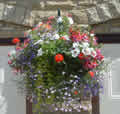
When assembling your hanging basket, place a short length of 2" plastic tubing down the centre to allow water to reach the roots easier when watering.
Before planting your hanging basket, place a plastic saucer in the bottom to help retain water and prevent drying out too much.
Perennials
Aquilegias - Don't feed too much
as it can make plants flop over after heavy rain.
Delphiniums - To produce outstanding blooms, plants need a steady supply
of moisture at the roots during the growing season. Mulch
to keep in moisture.
Dianthus -
If plants have pale tips they may be suffering from a shortage
of magnesium. Mix 1 oz of Epsom Salts to 1 gallon of water
and water each plant.
Hostas - Plant variegated forms next to terracotta water
features for a fresh look.
Ophiopogon
planiscapus 'Nigrescens' - Plants can disappear
into surrounding soil as it is dark. Plant next to
pale stone or grow amongst silver-leaved sempervivums.
Shrubs
and Climbers
Acid Lovers - Feed with Sequestrene
in June. Water around Rhododendrons, Camellias, Azaleas, Pieris
and all other acid loving plants to prevent yellow leaves
and encourage strong growth.
Camellias -
Flowerbuds are formed in the Summer, so ensure plants are
kept moist during July and August. Drought will cause flower
buds to drop off in Spring.
Garrya - A
handful of pelleted chicken manure in April and a monthly
feed of tomato fertiliser between June and September will
help promote growth and catkins.
Hedges - Use
Thuja plicata instead of Leylandii as it has the ability to
throw new shoots out of old wood, unlike Leylandii.
Hedges - When
trimming a hedge, the base should be wider than the top.
Ivy - The secret
of getting a new ivy to cling to your walls is to cut it hard
back after planting. New shoots get a grip straight away -
old ones never do.
General Hints and Tips
Houseplants - If you have an aquarium,
save the water each time you change it to water your house
plants with. You'll be amazed at the results.
Plant Labels - Remove top and bottom of fizzy drink cans, flatten out and cut into strips. Use as permanent plant labels by writing on them with a biro to emboss the letters.
Ponds - When
building a new pond, remember that siting it in full sun will
encourage the growth of algae, so position it in the shade.
Weeds - When
hoeing the ground, only disturb the top 1/2"
of soil. Going deeper than this will cause more weed seeds
to germinate.
Greenhouse
Begonias - If you have difficulty
in telling which way up a tuber should be planted, place in
a plastic bag with enough moist, peat based compost to cover
it, seal top, put in a warm place such as the airing cupboard
and gently shake bag every day to disturb it. Once you see
signs of growth, take it out and pot up with shoots uppermost.
Cucumbers -
Avoid watering with cold or chlorinated water, leave to stand
for a few hours before use.
Heating - Place
a few dustbins filled with water under greenhouse staging.
The water heats up during the day, releasing its warmth slowly
at night. Concrete floors also provide the same benefit.
Tomatoes - Try Epson Salt (1tsp) around tomato plants to green
up the foliage.
Watering - Use a cork on a cane to see if a plant is in need
of watering. If the plant is thirsty, the pot will ring
like a bell when tapped otherwise it will sound like
a dull thud.
Watering -
Never use water collected from water butts to water seedlings.
Use tap water, but allow it to stand for a couple of hours
before use to ensure the chlorine disappears.
Other
Hints & Tips Websites
Hints, tips,
general information and advice on many different subjects.
Flower and Garden Tips - Heaps of support and pots of advice for the budding gardener! Send us your questions or great ideas.
GardenGuideUK - Free and impartial guide for gardeners. Find out how to do anything!
DISCLAIMER:
Debby's Garden Links is not responsible for the content or reliability of any websites
linked from this site, and cannot accept liability for any damage or loss arising from
reliance on such websites.
We cannot guarantee that these links will work all of the time
and we have no control over the availability of the linked pages.